Anywhere Group travel
Group trip budget: split costs without the confusion
A group trip budget needs to answer two different questions: what will each person spend, and who needs to pay whom? Separate those questions before anyone books. This four-person example shows how to agree a comfortable total, divide shared costs and settle the balance without charging someone for an activity they skipped.

Photo: Vitaly Gariev · Unsplash License · Cropped for layout.
- Worked example
- 4 friends · 4 days · 3 nights
- Shared expenses
- $920 total · $230 per person
- Personal budget
- $600 before optional activities
- Prices
- Illustrative USD amounts, not quotes
In this guide
The short version
Agree the total, then agree the split
Build each traveler’s budget from shared costs, personal costs, optional activities and an unspent reserve. Decide how each shared item will be divided before paying. Record the actual payer and each participant’s agreed share, then settle the difference after refunds and changes are included.
Ask for a comfortable total before choosing the trip
Let each person share a comfortable spending limit privately if they prefer. Agree what that number includes: getting to the destination, accommodation, food, local transport and activities. A friend who says “my budget is $600” may mean the whole journey, while someone else may mean spending after flights.
Choose a plan that works for the people actually coming. An optional upgrade should stay optional; it should not quietly increase everyone’s share. For the wider sequence of dates, destinations and booking responsibilities, use our group trip planning guide.
Swipe or scroll to see all columns.
| Cost type | Example | Decision to record |
|---|---|---|
| Shared fixed cost | An apartment for three nights | Who benefits, how it is split and what happens if the group changes. |
| Personal cost | Each person’s journey to the destination | Who books it and whether it is included in their total budget. |
| Optional cost | A class that only three friends want | Only the confirmed participants fund it, unless everyone agrees otherwise. |
| Reserve | Money each person keeps available | It is unspent capacity, not an expense or a debt to the organizer. |
Keep an estimate separate from a confirmed price. Add the full amount payable, including any known taxes, fees and required extras. Put a date beside a quote so the group knows when to check it again.
Build a four-person budget from the bottom up
Here is an original planning example for four friends away for four days and three nights. All figures are illustrative US dollars, not destination prices. Everyone uses the accommodation, transfers and groceries equally, so they agree to divide those three costs equally.
Swipe or scroll to see all columns.
| Item | Group total | Each person |
|---|---|---|
| Accommodation, three nights | $720 | $180 |
| Shared arrival and departure transfers | $120 | $30 |
| Breakfast groceries and shared snacks | $80 | $20 |
| Total shared expenses | $920 | $230 |
Swipe or scroll to see all columns.
| Item | Amount | What it includes |
|---|---|---|
| Share of group expenses | $230 | The three shared items above. |
| Personal journey | $180 | Their own return travel to the destination. |
| Other meals | $140 | $35 per day for four days, excluding the shared groceries above. |
| Planned spending | $550 | Shared and personal expenses combined. |
| Unspent personal reserve | $50 | Kept available for changes; not paid to the group. |
| Budget before optional activities | $600 | Planned spending plus reserve. |
Three friends also choose a $60-per-person activity. Their individual budgets become $660 each; the fourth person’s stays $600. The group’s combined budget is $2,580, including $200 in unspent reserves. That total is not the amount the organizer needs to collect.
Choose the split before someone puts down a card
Equal shares are simple when everyone receives the same thing for the same time. Different room types, different arrival dates or different activity choices need an explicit agreement. Paying first does not make someone responsible for the entire final cost.
Swipe or scroll to see all columns.
| Situation | A workable approach |
|---|---|
| Same room setup and same nights | Equal shares, if everyone agrees. |
| One room has an agreed upgrade | Assign the agreed extra cost to its occupants, then divide the remaining base cost as agreed. |
| People stay different nights | Price each night and agree its participants and shares; fixed booking costs may need a separate rule. |
| Only some people join an activity | Divide its actual cost among those participants. |
| Someone buys personal items with group groceries | Separate personal items on the receipt before dividing the shared subtotal. |
Write down the agreement while it is still easy to change the plan. A short note such as “four equal shares of the apartment; workshop paid only by its three participants” is enough to prevent a later assumption becoming a disagreement.
If money is collected in advance, record it as an advance toward that person’s share. Do not count both their contribution and the organizer’s payment to the provider as two trip expenses.
Work out who owes whom with a simple balance
For each shared expense, record the date, description, actual amount, payer, participants and split. Keep the receipt or booking reference beside it. In our example, Asha pays for accommodation, Ben pays for transfers, Cara buys the groceries and Dan has not paid a shared bill yet.
Swipe or scroll to see all columns.
| Traveler | Already paid | Agreed share | Balance |
|---|---|---|---|
| Asha | $720 | $230 | Receives $490 |
| Ben | $120 | $230 | Pays $110 |
| Cara | $80 | $230 | Pays $150 |
| Dan | $0 | $230 | Pays $230 |
| Total | $920 | $920 | Payments and receipts balance |
Ben sends Asha $110, Cara sends Asha $150 and Dan sends Asha $230. Asha receives $490, leaving her net shared cost at $230. Each of the other friends also ends with a $230 shared cost. Personal journeys, other meals, optional activities and reserves are outside this settlement.
Use one agreed currency for the final ledger. Keep the original receipt amount and record how any conversion was determined, such as the actual settled charge, so everyone can follow the calculation. Add relevant payment fees explicitly rather than hiding them in a rounded balance.
Mark reimbursements as settlements, not new expenses. Before sending money, check the recipient details directly and confirm the amount with the group’s final ledger.
Recalculate when bookings or participants change
A departure from the group can affect both the price and the split. If the same $920 of shared costs remains and three remaining travelers agree to cover it equally, two pay $306.67 and one pays $306.66. Assign the rounding cent explicitly. That arithmetic does not decide what the departing traveler owes; the booking terms and the group’s agreement still matter.
First ask what can actually be canceled, reduced or refunded. A smaller room, fewer activity tickets or reduced groceries may change the total. Do not automatically divide an old estimate among fewer people.
The FTC’s travel-shopping guidance recommends checking cancellation and refund policies before paying and knowing the company you are buying from. Save those terms with shared bookings so the group can discuss an actual change instead of guessing.
When a refund arrives, apply it to the original expense and its agreed participants. If people have already reimbursed the payer, return or credit the appropriate shares. Keep pending refunds separate from received refunds, and agree when you will do the final reconciliation.
Do one final budget check before booking
Keep the expense ledger in a spreadsheet or expense tool everyone can follow. Keep the trip’s dates, itinerary and reservation notes together in your travel plan, and add a link or clear reference to the ledger. For the remaining preparation, work through our before-departure travel checklist and shared packing checklist.
After the trip, confirm the last receipts and refunds, agree the final balances and record completed payments. Save the final version so nobody has to reconstruct the arrangement from scattered messages.
From reading to ready
Give the group a shared plan to work from
Organize the itinerary, reservation notes and shared packing responsibilities in Oreviyo so the group can find the plan behind its budget. Keep your expense ledger in the tool you choose for tracking costs.
Explore group trip planning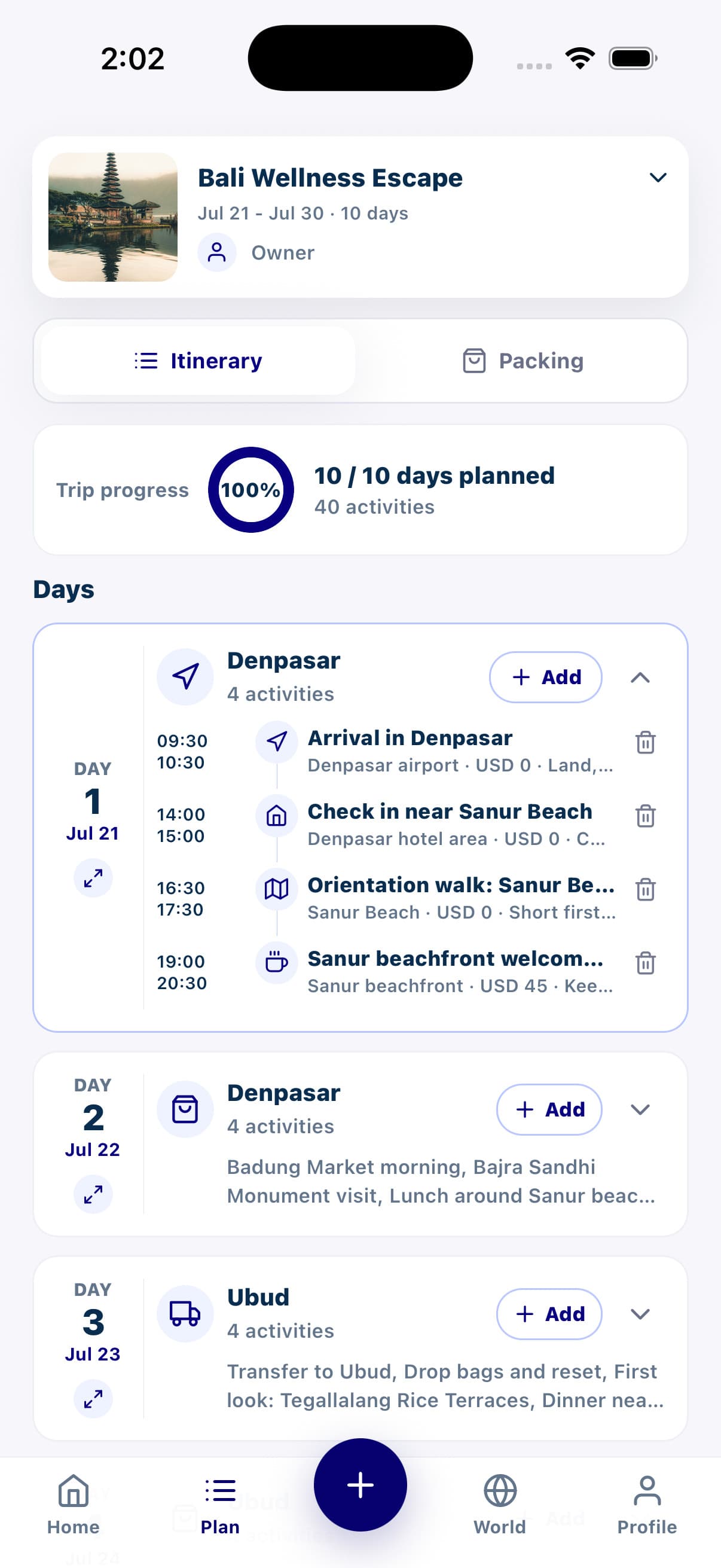
Common questions
Should every group trip cost be divided equally?
Does the organizer collect each person’s entire budget?
How do we split accommodation when rooms are different?
What happens if someone drops out?
Is the reserve part of what we owe each other?
Sources and useful links
Researched by Oreviyo using the sources below, reviewed on October 21, 2026. The routes, quantities, and packing examples are our suggestions. Confirm current conditions, access, and booking details before you go.
- Travel shopping and booking checksU.S. Federal Trade Commission